


WordPress vs Custom Website: Which is Better for Your Business
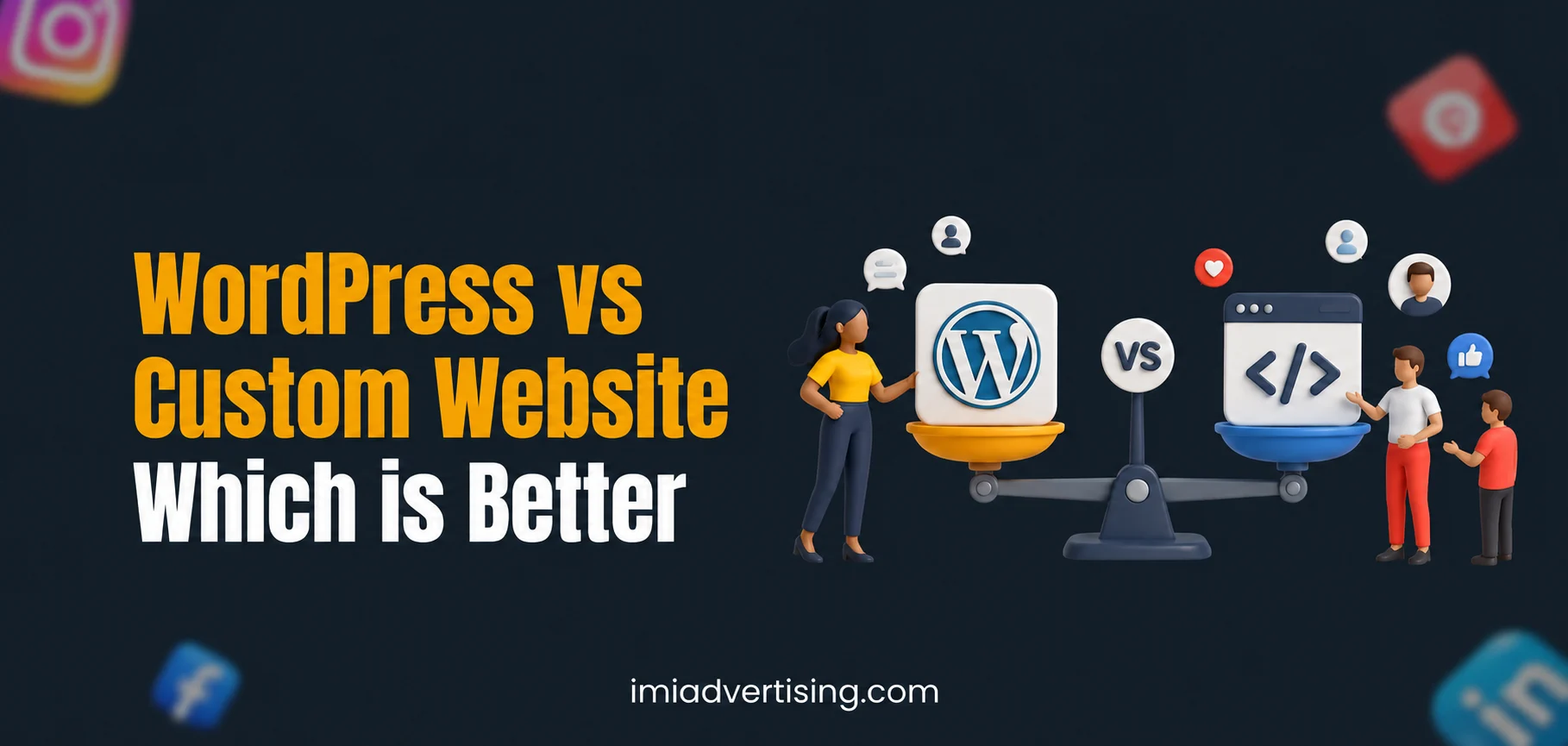
Every business needs a website that attracts customers, builds trust, and supports long-term growth. One of the biggest decisions during website development is choosing between WordPress and a custom-built website. While both options can deliver excellent results, the right choice depends on your budget, business goals, scalability requirements, and maintenance preferences. In this guide, we’ll compare WordPress vs Custom Website across cost, SEO, performance, security, and long-term value to help you make an informed decision.
1. What Is WordPress?
WordPress is an open-source content management system (CMS) that lets you build and manage a website using pre-built themes and plugins instead of writing code from scratch. You can install it yourself or hire a web designer in Ahmedabad to set it up, customize the theme, and configure it for speed and SEO.
WordPress Advantages
- Lower cost – hosting typically runs ₹500–₹4,000/month, and the core software is free
- Faster launch – a functional business website can go live in 1–3 weeks
- Easy self-editing – update text, images, and blog posts without calling a developer every time
- Built-in SEO foundation – plugins like Rank Math and Yoast simplify meta tags, sitemaps, and schema
- Huge plugin ecosystem – over 60,000 plugins cover booking systems, payment gateways, and more
WordPress Disadvantages
- Frequent plugin and core updates are required to stay secure
- Poorly coded themes or too many plugins can slow the site down
- Heavily customized designs may still need developer support
2. What Is a Custom Website?
A custom website is coded from the ground up, often using frameworks like React, Next.js, or plain HTML/CSS, with no reliance on a pre-built CMS structure. Every page, form, and function is built specifically for your business.
Custom Website Advantages
- Complete design freedom – no theme limitations
- Optimized performance – only the code your site actually needs gets loaded
- Stronger security by default – fewer third-party plugins mean a smaller attack surface
- Built for scale – ideal for platforms handling heavy traffic or complex logic
Custom Website Disadvantages
- Significantly higher upfront cost (₹1,50,000 and upward for a professional build)
- Longer development timelines, often 2–4 months
- You’ll always need a developer for future changes
- No large plugin community to fall back on for quick fixes
WordPress vs Custom Website: Side-by-Side Comparison
| Factor | WordPress | Custom Website |
|---|---|---|
| Starting cost | ₹15,000–₹1,50,000 | ₹1,50,000–₹10,00,000+ |
| Launch time | 1–4 weeks | 8–16 weeks |
| Self-editing | Easy, no coding needed | Requires a developer |
| SEO control | Strong, plugin-assisted | Full, code-level control |
| Speed potential | Good with optimization | Excellent by default |
| Security | Needs regular updates | Smaller attack surface |
| Best for | SMBs, blogs, service businesses, e-commerce | Enterprise platforms, SaaS, highly unique functionality |
Cost: What Actually Drives the Price
The biggest difference between WordPress vs Custom Website is development cost. WordPress uses a ready-made CMS, allowing developers to build professional websites faster and at a lower cost. A custom website requires every feature to be designed and coded from scratch, making it a much larger investment.
For most business websites, WordPress offers better value because it reduces both development and maintenance costs. A custom website is worth considering only if your project requires advanced features, custom workflows, or enterprise-level functionality.
| Website Type | Estimated Cost |
|---|---|
| Basic WordPress Website | ₹15,000–₹40,000 |
| Business Website | ₹40,000–₹1,00,000 |
| WordPress eCommerce Website | ₹60,000–₹1,50,000+ |
| Custom Website | ₹1,50,000–₹10,00,000+ |
SEO Capability: Why This Matters for Businesses
Both WordPress and custom websites can rank well on Google when they are optimized correctly. The platform alone doesn’t improve rankings technical SEO, quality content, and a well-planned SEO strategy make the biggest difference.
WordPress makes SEO easier with tools like Rank Math and Yoast SEO, while custom websites offer greater technical flexibility for developers. For most businesses, a professionally optimized WordPress website provides everything needed to achieve strong search visibility.
A. Performance & Speed
A common myth is that WordPress is always slower than a custom website. In reality, website speed depends on hosting, image optimization, caching, and how well the website is built, not just the platform.
Custom websites have an advantage for large-scale applications because they use only the code that’s needed. However, a well-optimized WordPress website can deliver excellent performance for business websites, portfolios, blogs, and online stores.
B. Security Comparison
Both WordPress and custom websites can be highly secure when maintained properly. Regular updates, SSL certificates, secure hosting, and strong passwords play a much bigger role in website security than the platform itself.
Custom websites rely less on third-party plugins, while WordPress benefits from a mature ecosystem of trusted security tools. With regular maintenance, both platforms can provide a secure experience for businesses and customers.
C. Performance & Maintenance
Every website requires ongoing maintenance after launch. This includes software updates, backups, performance monitoring, and security checks to ensure everything continues running smoothly.
WordPress makes maintenance easier because most updates can be completed quickly or even automated. Custom websites usually require developer support for changes, making them more suitable for businesses with dedicated technical resources.
Which Platform Offers Better Long-Term Value?
If your goal is to launch a professional website quickly, improve SEO, and manage content without depending on a developer, WordPress delivers the best long-term value for most businesses.
A custom website is a better investment when your business requires unique functionality, complex integrations, or enterprise-level scalability. Choosing the right platform should always depend on your business goals rather than simply your budget.
How to Decide: A Practical Checklist
Choose WordPress if you:
- Need to launch within a month
- Want to edit content yourself without calling a developer
- Have a budget under ₹1,50,000
- Run a standard business site, blog, or online store
Choose a Custom Website if you:
- Need functionality no plugin can replicate
- Expect very high traffic or complex data operations
- Have a budget and timeline that supports months of development
- Require a completely unique brand experience competitors can’t copy
Common Mistakes When Choosing a Website Platform
- Choosing WordPress because it’s cheaper without considering future needs.
- Paying for custom development when a WordPress solution would be sufficient.
- Ignoring SEO while focusing only on design.
- Installing too many plugins, causing slow performance.
- Not planning for long-term maintenance costs
Our Recommendation
If your business needs a professional website for lead generation, SEO, blogging, or e-commerce, WordPress is usually the best choice because it is cost-effective, easy to manage, and quick to launch.
If you require enterprise software, advanced integrations, or highly customized functionality, a custom website offers greater flexibility but at a significantly higher cost and development time.
Not sure which option is right for your business? Talk to our website design experts in Ahmedabad for a free consultation and a platform recommendation tailored to your goals.
FAQs:
If you need a standard business site with 10–15 pages, a blog, contact forms, and basic e-commerce, WordPress is enough. If you need unique functionality, heavy traffic handling, or third-party system integrations, custom development is the better choice.
A WordPress site typically costs ₹15,000–₹80,000 (design + plugins + hosting). A custom website usually starts around ₹1.5 lakh and can go up to several lakhs depending on functionality.
Yes, but it requires regular plugin/theme updates and proper hosting security. Outdated plugins are responsible for roughly 90% of WordPress hacks.
If you install too many plugins or use heavy themes, yes, speed drops. This can largely be avoided with proper caching and lightweight plugins.
Managed WordPress hosting (like Kinsta or WP Engine) can handle high traffic well, but at a very large scale (lakhs of concurrent users), custom infrastructure performs better.
WordPress: roughly ₹2,000–₹10,000/month (updates, backups, security). Custom sites usually cost more due to higher developer dependency.
Get in touch with us for
Digital Marketing Services
09313100658
Available From 09:30 – 06:30
Email: support@imiadvertising.com