


10 Things That Matter When Designing a Business Website
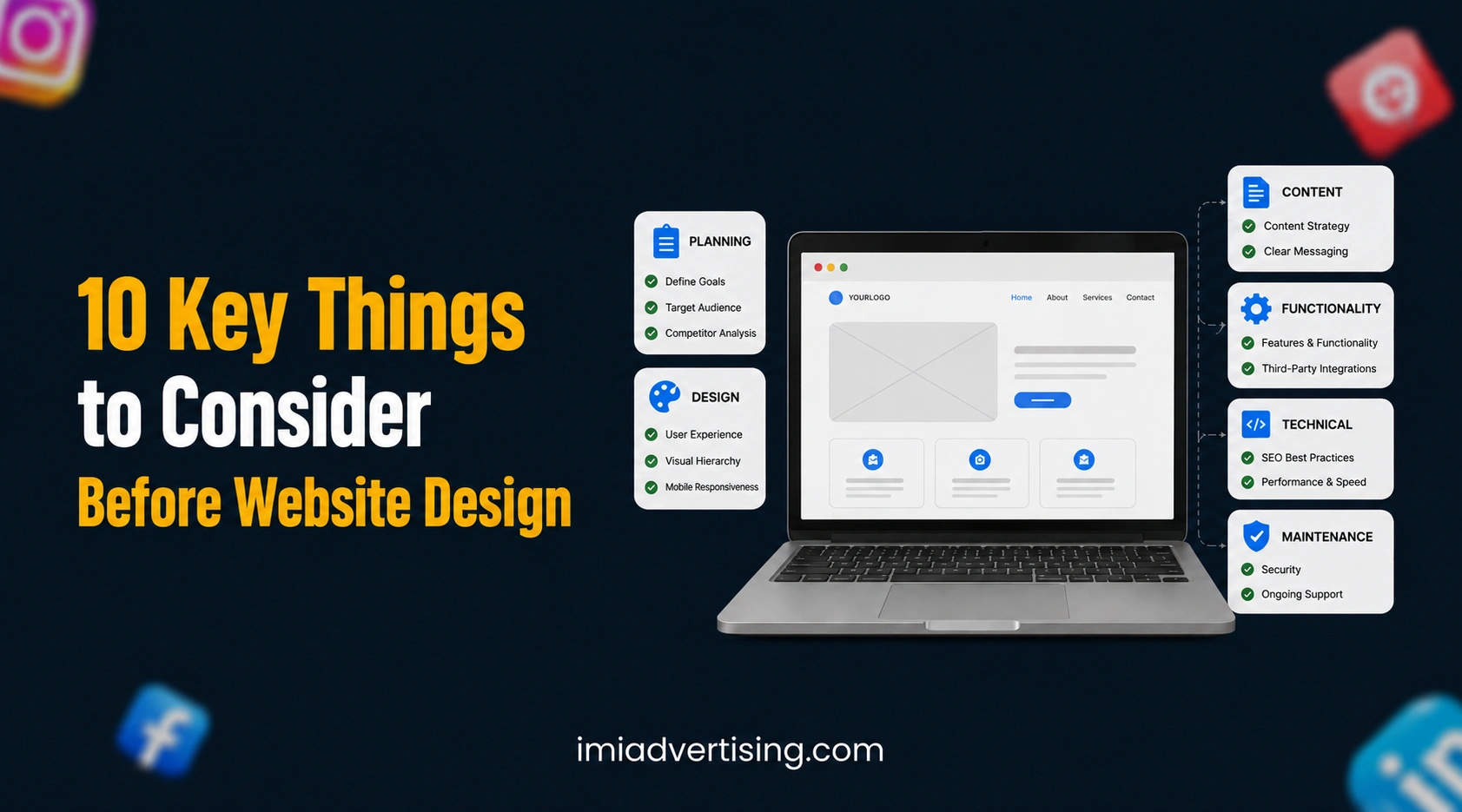
A website should be planned around what customers need to see, understand, and do, not simply how the homepage looks. Before starting from zero, business owners should fix the website goal, page structure, content, branding, mobile experience, SEO, enquiry flow and future marketing requirements. Most customers will visit from their phones, so the website needs to be easy to use on smaller screens from the beginning. Making these decisions early can prevent unnecessary redesigns, missing pages and SEO issues after launch.
What to Plan Before Starting Your Website
At IMI Advertising, website development is planned alongside digital marketing so the website has a clear purpose beyond its visual design. This approach helps businesses build a website that can support visibility, enquiries, and future campaigns from the beginning.
1. Fix the Main Purpose of the Website
First, decide what the website needs to achieve. Is the main goal to generate enquiries, receive calls, book appointments, sell products, or build trust? This decision should come before choosing layouts because it determines what visitors need to see and what action they should take.
A service-based website, for instance, may need strong service pages and enquiry options, while an e-commerce website will need a completely different customer journey. Keep one primary conversion goal for the website and make the important pages support it.
2. Understand Who Will Use the Website
Your website should answer the questions your customers actually have. Before development begins, identify who you want to attract, what they are looking for, and what information they need before contacting your business.
Think about questions related to your services, process, pricing approach, location, experience, and trust. These answers can then guide the page structure, headings, content and CTA placement instead of adding information simply because there is space on the page.
3. Plan the Sitemap Before Designing Pages
Do not start designing individual pages without first deciding how the website will be organised. Prepare the sitemap and decide which pages belong under the main navigation and how users will move between related pages.
Your initial structure may include:
- Home
- About
- Services
- Individual service pages
- Portfolio or case studies
- Blog
- Contact
- Location pages, where relevant
Also consider future services and content before finalising the structure. Changing the architecture after development can create unnecessary work and may affect URLs and SEO.
4. Decide the Content Before Final Design
Content should not be an afterthought. If the design is completed first, the final copy may have to fit into sections that were never designed around the actual information customers need.
Prepare the main headings, service information, USPs, trust signals, FAQs and CTAs before approving the final design. This gives the designer enough information to create sections that feel natural instead of filling the website with oversized banners and unnecessary visual elements.
5. Keep Mobile-Friendly Design at the Centre
Mobile usability needs to be considered from the first design stage. Customers should be able to read the content, open the menu, tap buttons, complete forms and find contact information without zooming or struggling with the layout.
Pay attention to font sizes, spacing, image scaling, button placement and form length. A website can look polished on a desktop but still create a poor experience if the mobile version feels crowded or difficult to navigate.
6. Fix Your Logo and Brand Colours Early
Your website should maintain the same visual identity as the rest of your business. Finalise the logo, brand colours, colour codes, fonts and basic design style before the website moves into development.
Providing exact HEX colour codes is useful because it keeps buttons, headings, backgrounds and other design elements consistent across pages. The logo should also be supplied in suitable formats and versions so it remains clear across desktop, mobile and other digital platforms.
This stage should also establish the typography hierarchy, CTA style, icons and overall visual direction. Fixing these details early reduces repeated design changes later.
7. Create a Clear Navigation and User Journey
A visitor should not have to search for basic information. Keep the main navigation focused on the pages that matter most and use familiar labels so users immediately understand where each option will take them.
The page journey also matters. After reading about a service, the visitor should have an obvious next step, whether that means contacting the business, requesting information, viewing related work, or moving to another relevant service page.
8. Plan SEO From Day One
SEO should be part of website planning rather than a task added after development. Each important page should have a clear search purpose, target keyword, URL, and heading structure.
For businesses targeting Ahmedabad, keywords such as website design company in Ahmedabad, digital marketing company in Ahmedabad, marketing agency in Ahmedabad, and advertising agency in Ahmedabad should be mapped to relevant pages naturally. Avoid putting every keyword on every page; each term should have a logical place within the website.
Also decide the internal linking structure, metadata, image alt text and location targeting before launch.
9. Plan Speed, Security and Accessibility
Design choices can affect how quickly a website loads. Large images, unnecessary animations and excessive scripts can make pages heavier, particularly for mobile users.
Before launch, check image optimisation, HTTPS, forms, software updates and basic accessibility. Text should remain readable, important buttons should be usable, and the website should work properly across common devices. These are website requirements, not optional finishing touches.
10. Build It for Future Marketing
Do not build the website only for what the business needs today. If you plan to invest in SEO, Google Ads, social media, content marketing or location-based campaigns later, the website should have enough flexibility to support them.
This is where combining website development with digital marketing can be useful. At IMI Advertising, website development is considered alongside marketing requirements so the website can support ongoing visibility and lead generation without requiring major structural changes whenever a new campaign or service is introduced.
Final Checks Before Launch
Before publishing the website, complete one final review of the entire user experience. Check forms, CTAs, mobile layouts, URLs, redirects, internal links, metadata, images, contact details, and analytics tracking.
Also verify that the logo, colour codes, fonts and other brand elements remain consistent across the website. A final review at this stage can catch small issues before they affect real visitors.
Conclusion
Good website design starts well before the first page is developed. Business owners should decide the purpose, audience, sitemap, content, branding, mobile experience, SEO structure, and future marketing requirements before approving the final design.
The objective is simple: create a website that is easy for customers to understand, easy for them to use, and ready to support the business as it grows.
FAQs:
Yes. The business should ideally control the domain registration and renewal rather than depending entirely on an outside agency or developer.
Yes. A redesign can usually keep the same domain, but URLs and page structures should be handled carefully so existing search visibility and useful backlinks are not unnecessarily lost.
Provide the original high-quality logo files whenever possible, preferably in editable or vector formats, along with approved variations for light and dark backgrounds if available.
Exact colour codes help maintain consistency across buttons, backgrounds, headings, and other elements. Without fixed codes, the same brand colour can appear slightly different across different pages.
Ideally, yes. Setting up analytics and search monitoring before launch gives the business a clean starting point for measuring traffic, user behaviour and website performance.
Get in touch with us for
Digital Marketing Services
09313100658
Available From 09:30 – 06:30
Email: support@imiadvertising.com