


Write an SEO-Friendly Blog That Actually Ranks on Google & AI Search
Google now answers most informational queries directly inside AI Overviews before a user ever clicks a link. At the same time, tools like ChatGPT, Gemini, and Perplexity are pulling their answers from well-structured web content, not just top-ranking pages. If your blog isn’t built for both classic Google rankings and this new AI-driven search layer, you’re already losing visibility you don’t know you’re losing.
This guide breaks down exactly how to write a blog post that ranks in traditional search, gets pulled into AI Overviews, and gets cited by AI assistants. The same framework our team at IMI Advertising uses for clients across Ahmedabad and beyond.
What Makes a Blog Post “SEO-Friendly”?
An SEO-friendly blog post is content structured so both search engines and readers can quickly understand what it’s about, trust its accuracy, and find the specific answer they need. It combines three things:
- Relevance – it matches real search intent, not just a keyword
- Structure – clear headings, short paragraphs, and scannable formatting
- Credibility – demonstrated expertise, accurate facts, and trustworthy sourcing (E-E-A-T)
Miss any one of these, and you’ll struggle to rank, regardless of how well-written the content is.
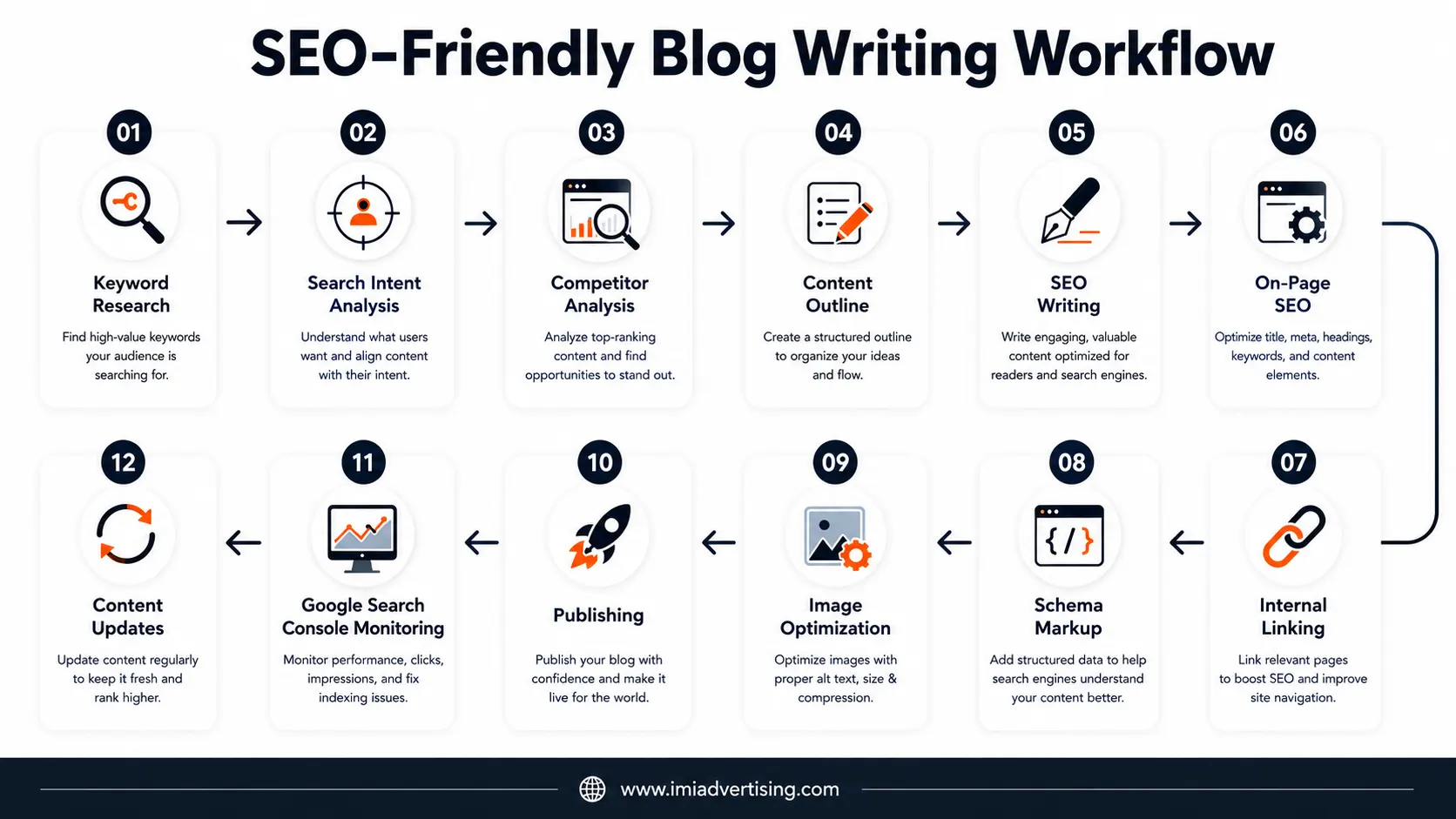
9 Steps to Write an SEO-Friendly Blog That Ranks
Based on our experience delivering SEO services in Ahmedabad, we’ve discovered the most impactful ranking signals that influence Google’s search results. These 9 proven SEO elements help your content compete with high-ranking pages and improve its chances of reaching the top of Google. Always verify these factors before publishing your blog.
1. Start with Real Search Intent, Not Just a Keyword
Before writing a single line, ask, “What is the searcher actually trying to accomplish? Someone searching “SEO services in Ahmedabad” isn’t looking for a definition of SEO, they’re comparing providers. Match your content format to that intent.
2. Build a Topic Cluster Around Your Primary Keyword
Instead of stuffing one keyword repeatedly, use semantic variations and related entities naturally:
- Primary term: SEO-friendly blog writing
- Related entities: on-page SEO, keyword research, E-E-A-T, content structure, technical SEO, AI Overviews, featured snippets
This tells search engines and LLMs that your content covers the topic comprehensively, not superficially.
3. Structure for Both Humans and Machines
Use a clear heading hierarchy:
- H1 – one per page, contains the primary keyword
- H2 – major sections
- H3/H4 – sub-points, steps, or comparisons
Keep paragraphs to 2 – 4 sentences. AI systems and skim-reading users both favor content broken into short, digestible chunks.
4. Answer Questions Directly (for Featured Snippets and AI Overviews)
Every H2 or H3 that reads like a question should be followed by a direct answer in the first sentence, then supporting detail. This single habit is one of the fastest ways to get pulled into a featured snippet or AI-generated answer box.
5. Add First-Hand Expertise and Specifics
Generic advice doesn’t rank well anymore. Include:
- Real examples from your own work or industry
- Specific numbers, timeframes, or outcomes where accurate
- Practical recommendations a beginner couldn’t guess on their own
This is the core of E-E-A-T (Experience, Expertise, Authoritativeness, Trustworthiness), one of Google’s most heavily weighted quality signals.
6. Optimize On-Page Elements
| Element | Best Practice |
|---|---|
| Title Tag | Under 60 characters, primary keyword near the front |
| Meta Description | 150–155 characters, includes a reason to click |
| URL Slug | Short, keyword-focused, no stop words |
| Image Alt Text | Descriptive, includes relevant keyword variation |
| Internal Links | 3–5 links to related, relevant pages |
| External Links | 1–2 links to authoritative, non-competing sources |
7. Add an FAQ section with schema markup.
FAQ sections formatted with structured data (FAQ schema) are one of the most reliable ways to appear in Google’s “People Also Ask” boxes and AI-generated summaries. Keep each answer under 40–50 words and factually specific.
8. Don’t Ignore Technical SEO
Even great content underperforms on a slow, unoptimized site. Check:
- Mobile page speed (under 3 seconds ideally)
- Core Web Vitals scores
- Proper heading hierarchy in the HTML (not just visual styling)
- Crawlability and indexing status
9. Promote, Track, and Update the Content
Publishing isn’t the finish line. Share the post through relevant channels, monitor rankings and traffic in Google Search Console, and revisit the post every few months to update stats, examples, or outdated information. Content that gets refreshed regularly tends to hold its rankings and its AI overview citations far longer than content published once and forgotten.
Common Mistakes That Kill Blog Rankings
| Mistake | What to Do Instead |
|---|---|
| Keyword Stuffing | Write for topics; keep keyword density natural at 1–2%. |
| No Search-Intent Match | Copy the format of top-ranking pages, then make yours better. |
| Thin 300-Word Posts | Cover the topic fully-depth beats arbitrary length quotas. |
| Zero Internal Links | Link every post to 3–5 relevant service or blog pages. |
| Publish and Forget | Refresh content with new data every 6–12 months. |
When Should You Hire an SEO Company?
Writing one good post is manageable. Ranking consistently, keyword strategy, technical SEO, link building, content calendars, and monthly analysis are a full-time job. That’s where partnering with the right agency pays for itself.
As the best SEO company in Ahmedabad trusted by 100+ brands, IMI Advertising offers complete SEO services in Ahmedabad and across India:
| Service | What You Get |
|---|---|
| SEO Strategy & Keyword Research | Intent-mapped keyword plans built on real competitor data |
| SEO Content Writing | Blogs and landing pages written for rankings and AI citations |
| On-Page & Technical SEO | Site structure, speed, schema, and crawlability fixes |
| Local SEO | Google Business Profile optimisation to win “near me” searches |
| Link Building & PR | Authority-building backlinks from relevant publications |
| Monthly Reporting | Transparent dashboards, rankings, traffic, and leads—not vanity metrics |
Why brands choose IMI Advertising:
- Google Partner agency with a performance-first, ROI-focused approach
- Full-stack team, SEO, content, PPC, social media, and web development under one roof
- Trusted by brands like O General, NFSU, Keyos Beauty, and Taranovs Pizza
- Serving clients across India and the UK from our Ahmedabad headquarters
Key Takeaways
- SEO-friendly writing means optimizing for three layers: Google rankings, featured snippets, and AI citations (GEO).
- Search intent decides your format. Study the top 5 results before writing.
- Answer-first introductions, FAQ blocks, and schema markup are the fastest routes into AI Overviews.
- Refreshing old posts every 6 – 12 months often recovers rankings faster than publishing new content.
- Consistent rankings need consistent strategy, that’s where a specialist SEO partner like IMI Advertising delivers compounding ROI.
FAQs:
It's a blog post structured around real search intent, clear headings, and credible, well-sourced content that both search engines and readers can easily understand and trust.
Most competitive topics rank best between 1,000 – 2,000 words, but length should match search intent, some queries need only a concise, direct answer.
Yes, but only lightly. A natural density of 1–2%, combined with semantic variations and related entities, works better than repeating one exact keyword.
Answer common questions directly within the first sentence of a relevant heading, use structured FAQ sections, and back claims with clear, factual detail.
An experienced SEO company brings ongoing keyword research, technical audits, content strategy, and performance tracking that's difficult to sustain consistently in-house.
Get in touch with us for
Digital Marketing Services
09313100658
Available From 09:30 – 06:30
Email: support@imiadvertising.com